The Cold Chain Behind the Stadium Beer Line
Jul 25, 2026A stadium sells beer at 3 °C to seventy thousand people across four hours. Getting there means a chain of refrigerated steps stretching back weeks, each one owned by a different party, each handoff a place where responsibility — and temperature — can be dropped.
The engineering lesson generalises well beyond drinks. Every cold chain fails the same way: not in the middle of a monitored space, but at the moments when the product moves between owners and nobody is measuring.
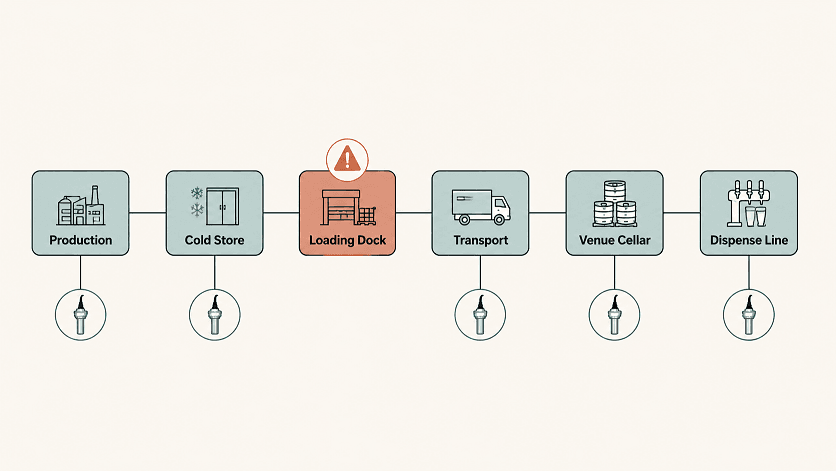
| Step | What must be known | Sensing approach | Why |
|---|---|---|---|
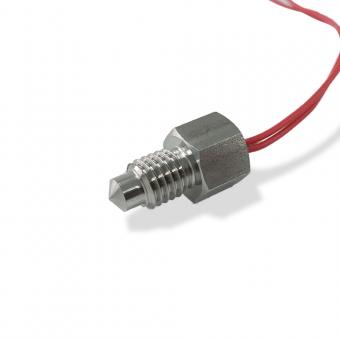
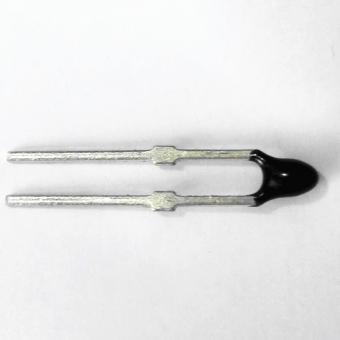
| Production / conditioning | Process temperature, tightly held | Immersion probe, platinum or precision NTC | Control point; accuracy is the product spec |
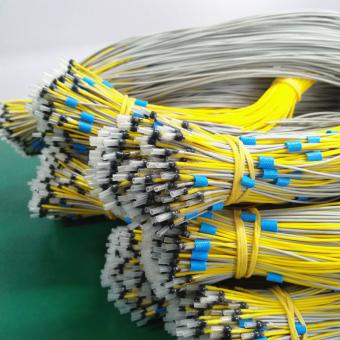
| Cold store | Space temperature, many points | Multi-drop digital (1-Wire) | Twenty points, one data line — wiring is the cost driver, not accuracy |
| Loading dock | Exposure time and peak | Logger / portable probe | The classic failure point — nobody owns the pallet on the dock |
| Transport | Continuous record over hours | Logger, battery-driven | Evidence, not control; low power is the constraint |
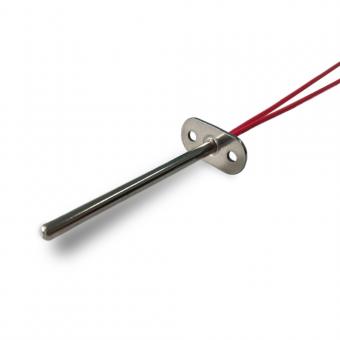
| Venue cellar | Space and coil temperature | NTC probe + defrost sensing | Control and defrost termination |
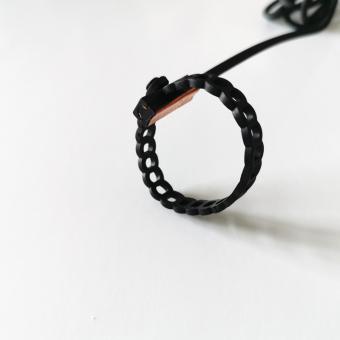
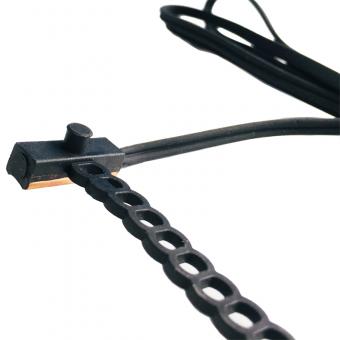
| Dispense line | Line temperature at delivery | Pipe-clamp NTC | Non-invasive on a wetted line; you cannot break into a product line |
Notice the pattern. Accuracy dominates at the ends — where the product is made and where it is delivered. In the middle, topology and evidence dominate. That distinction should drive the component choice, and it usually doesn't.
A cold store needs many points and modest accuracy. That is precisely the DS18B20's case. From the Focusensing FST DS18B20 datasheet: 9–12 bit user-selectable resolution, ±0.5 °C from −10 to +85 °C, 1-Wire open-drain interface, 12-bit conversion in 750 ms maximum, supply 3.0–5.5 V. (Focusens FST DS18B20 datasheet.)
The number that matters is not the ±0.5 °C. It is the word open-drain. Many addressable sensors share one data line — twenty probes, one pin, one cable run. Where the wiring is the expensive part and ±0.5 °C sits comfortably inside the product's tolerance band, that topology is worth more than accuracy you would never act on.
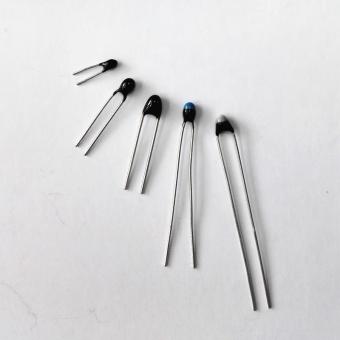
Choosing between a digital probe and a plain thermistor for a pack of points? DS18B20 vs NTC thermistors works the comparison through in detail.
A refrigeration evaporator ices up. Ice insulates, capacity falls, the system works harder to do less. So it defrosts — and then must decide when to stop. Terminate too early and ice remains and accumulates cycle over cycle. Terminate too late and you have heated the product for nothing.
That decision is made on a sensor reading, which makes defrost the one place in a refrigeration system where thermal lag is a product-quality parameter. The controller ends the cycle on what the sensor reports, not on what the coil is doing. If they disagree by two minutes, the two minutes come out of the product.
You cannot put a probe into a product line. Beyond the hygiene argument, every penetration is a leak path and a cleaning problem. So the line gets a clamp-on sensor — surface reading, no penetration, fitted in minutes to a live line.
Accept what that means: you are measuring the pipe, not the beer. On a thin, well-insulated line the offset is small and stable. On a bare line running through a warm corridor, the sensor is reporting a blend of product and corridor. If the number is a compliance record rather than a control input, insulate over the sensor — the cheapest accuracy improvement available in the whole chain.
Not the cold store. The cold store is instrumented, alarmed and owned. It breaks on the dock — the twenty minutes when a pallet sits between a truck and a door, belonging to nobody, measured by nothing. Every serious cold chain review lands on the same conclusion: instrument the handoffs, not just the boxes.
DS18B20 figures are from the Focusens FST DS18B20 datasheet page. Sensor-to-step mapping reflects standard refrigeration practice and is offered as engineering guidance, not as a manufacturer specification. Figures for other parts in the FST digital range are under document revision and are not quoted here.
No.1 XiSan Road, Electromechanical Industry Park , High&New Tech.Zone. Hefei,Anhui,China
tél : +86-551-69109668
Whatsapp : +86-13339100504
e-mail : info@focusens.com
Skype : melodyliu520






 +86-551-69109668