RTD lead resistance error: 1 ohm of cable is 2.56 C on a PT100
Sep 18, 2026The conversion is one division. What is usually missing is not the ratio but the rest of the arithmetic: which gauge, over what length, and which part of the error a third wire or a commissioning trim actually removes.
This page gives the number, the table, and the two cases where the usual rule of thumb is wrong.
A platinum RTD changes resistance at a rate set by IEC 60751. At 0 °C that rate is 0.3908 Ω per kelvin for a PT100 and 3.9083 Ω per kelvin for a PT1000. Divide the loop resistance by that slope and you have the error in degrees.
| Element | dR/dT at 0 °C (Ω/K) | at 25 °C | at 100 °C | 1 Ω of loop reads as |
|---|---|---|---|---|
| PT100 | 0.3908 | 0.3879 | 0.3793 | 2.56 °C |
| PT1000 | 3.9083 | 3.8794 | 3.7928 | 0.256 °C |
Slopes calculated from the Callendar-Van Dusen coefficients in IEC 60751. The slope falls slightly as the sensor heats, so the error a given cable causes grows a little with process temperature. Full values are in the PT100 and PT1000 resistance tables.
The slope is why the factor of ten exists and why it never goes away. It is not a tolerance, a grade, or a manufacturing difference. A PT1000 simply moves ten times further for the same degree.
On a 2-wire connection both conductors are in series with the element, so the loop is twice the one-way length. Copper resistance at 20 °C from the standard AWG table gives the numbers below.
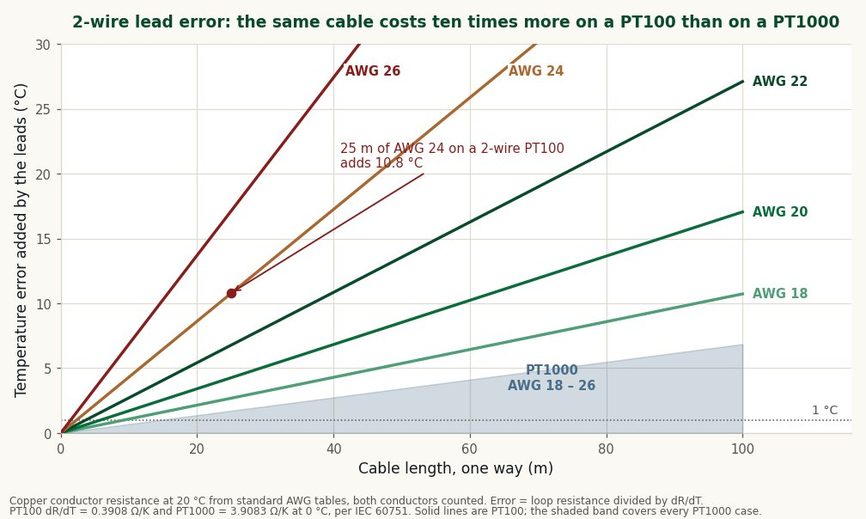
Every solid line is a PT100. The whole PT1000 range fits inside the shaded band at the bottom.
| Cable, one way | Loop Ω, AWG 18 / 22 / 24 | PT100 error °C | PT1000 error °C |
|---|---|---|---|
| 5 m | 0.21 / 0.53 / 0.84 | 0.5 / 1.4 / 2.2 | 0.05 / 0.14 / 0.22 |
| 10 m | 0.42 / 1.06 / 1.68 | 1.1 / 2.7 / 4.3 | 0.11 / 0.27 / 0.43 |
| 25 m | 1.05 / 2.65 / 4.21 | 2.7 / 6.8 / 10.8 | 0.27 / 0.68 / 1.08 |
| 50 m | 2.10 / 5.30 / 8.42 | 5.4 / 13.6 / 21.5 | 0.54 / 1.36 / 2.15 |
| 100 m | 4.19 / 10.59 / 16.84 | 10.7 / 27.1 / 43.1 | 1.07 / 2.71 / 4.31 |
Two-wire connection, copper at 20 °C, both conductors counted. Read the three numbers in each cell as AWG 18, AWG 22 and AWG 24. In metric terms those are roughly 0.82, 0.33 and 0.20 mm².
A 10 °C error on a Class A PT100 is roughly seventy times the element's own tolerance at 0 °C. At that point the sensor grade you paid for has stopped mattering.
A 3-wire connection does not remove lead resistance. It measures one conductor and subtracts it from the other two, which works only while all three conductors are identical.
They usually are, to within a fraction of a percent, when the cable is a single homogeneous run. The mismatch shows up somewhere else: a crimp that is not quite the same as its neighbour, a junction box where one conductor was extended, a terminal that has oxidised on one leg only.
This is the failure that gets mistaken for a bad sensor, because it is stable, plausible and temperature dependent. The 2-wire vs 3-wire vs 4-wire comparison covers the wiring schemes themselves.
A fixed lead resistance is an offset, and most RTD transmitters and PLC input cards let you trim an offset at commissioning. Where that trim exists and was used, the static term in the table above is already gone.
That changes which numbers matter. The 43 °C in the bottom-right cell is what an untrimmed 2-wire run would report, not what a commissioned loop reads. Treat the table as the size of the correction, not as live error.
Two cases where the trim is not available: a controller with no offset parameter, and a sensor that gets swapped for one on a different cable length without anyone re-running the trim. Both are common in retrofits.
Copper has a temperature coefficient of about 0.393 % per kelvin, close enough to a platinum RTD's own coefficient to be ironic. The lead resistance you measured on a cold bench is not the lead resistance you have in a hot cabinet.
Ten metres of AWG 22 is 1.06 Ω of loop at 20 °C. Put that harness in a 60 °C enclosure and it becomes 1.23 Ω. The extra 0.17 Ω is another 0.43 °C on a PT100.
On a 2-wire installation that drift is uncorrectable and it moves with the seasons, which is exactly the signature people report as "the reading creeps in summer". On a 3-wire run it cancels with everything else, provided the conductors still match.
Enter the loop resistance if you have measured it, or a cable length and gauge if you have not.
The calculator applies the copper coefficient to whichever ambient you enter, so a measured loop taken on a bench can be projected to the temperature the cable will actually see.
Adding a third conductor fixes the matched part of the error. Moving to a PT1000 divides every term by ten, including the parts a third wire cannot reach: the imbalance and the copper drift.
| Situation | What to do | Why |
|---|---|---|
| Short run, under about 5 m | 2-wire PT100 is usually fine | Error is a few tenths of a degree |
| 5-50 m, PT100 already specified | Go 3-wire | Cancels the matched resistance; imbalance remains |
| Long run and the controller accepts either element | PT1000, 2 or 3-wire | Every error term drops by a factor of ten |
| Calibration-grade, or a lab reference | 4-wire | The only scheme where lead resistance truly does not appear |
| Existing 2-wire cable that cannot be replaced | PT1000, or a transmitter at the sensor | Convert to a current signal before the long run |
The last row is the one that gets forgotten. A 4-20 mA transmitter mounted at the probe removes the problem entirely, because a current loop does not care about conductor resistance.
Whether that is worth the cost depends on whether the cable run is fixed. Our Class A PT1000 3-wire probes cover the middle two rows.
If you are choosing between the two elements for other reasons as well, the PT100 vs PT1000 comparison covers the rest, and the RTD guide covers how the element works. Mounting affects a different error budget entirely, which the sensor mounting guide deals with.
2.56 °C on a PT100 and 0.256 °C on a PT1000, at 0 °C. The figure grows slightly as the sensor gets hotter, reaching 2.64 °C per ohm at 100 °C on a PT100.
Some sources quote 2.60 °C. That comes from using the average coefficient 0.385 Ω/K over 0 to 100 °C rather than the derivative at 0 °C given by IEC 60751, which is 0.3908 Ω/K. Both are right about different things; this page uses the derivative throughout.
No. It cancels the part that is matched across the conductors. Any imbalance between them passes straight through. A 0.05 Ω mismatch is 0.13 °C on a PT100.
It depends on the accuracy you need. For 1 °C or better, roughly 4 m of AWG 22 or 9 m of AWG 18. For 0.1 °C, a 2-wire PT100 is not the right choice at any practical length.
On a 2-wire run, copper lead resistance rises about 0.393 % per kelvin. A harness that warms from 20 °C to 60 °C adds roughly 16 % to its own resistance, and on a PT100 that shows up as a fraction of a degree to a few degrees depending on length.
For lead error, yes, by a factor of ten. It is not automatically better overall: self-heating is higher for the same excitation current, and not every controller accepts both elements.
color:#11181D;font-family:Helvetica Neue , Arial, sans-serif;font-size:medium;white-space:normal;background:#FAF9F4;border:1px solid #DDD8CB;border-left:4px solid #0A6B3B;border-radius:4px;padding:16px 18px;margin:22px 0;line-height:1.75;Lead resistance is one way an RTD loop reads wrong. Fitting the wrong element type is the other, and it is far larger: a KTY84 on a PT1000 input is out by about 100 K, not by a degree. See KTY84 vs PT1000: what a drive reads with the wrong sensor.No.1 XiSan Road, Electromechanical Industry Park , High&New Tech.Zone. Hefei,Anhui,China
tél : +86-551-69109668
Whatsapp : +86-13339100504
e-mail : info@focusens.com
Skype : melodyliu520






 +86-551-69109668